Who are the Singapore fine-dining chefs flying the flag high in Hong Kong?
Advertisement
People
Who are the Singapore fine-dining chefs flight the flag high in Hong Kong?
Barry Quek, Nicholas Chew and Edward Voon – three Singapore chefs who flew the coop to make information technology big globally, and are now ensconced in Hong Kong. How are they faring amidst challenging times? And will they ever return to our little red dot?
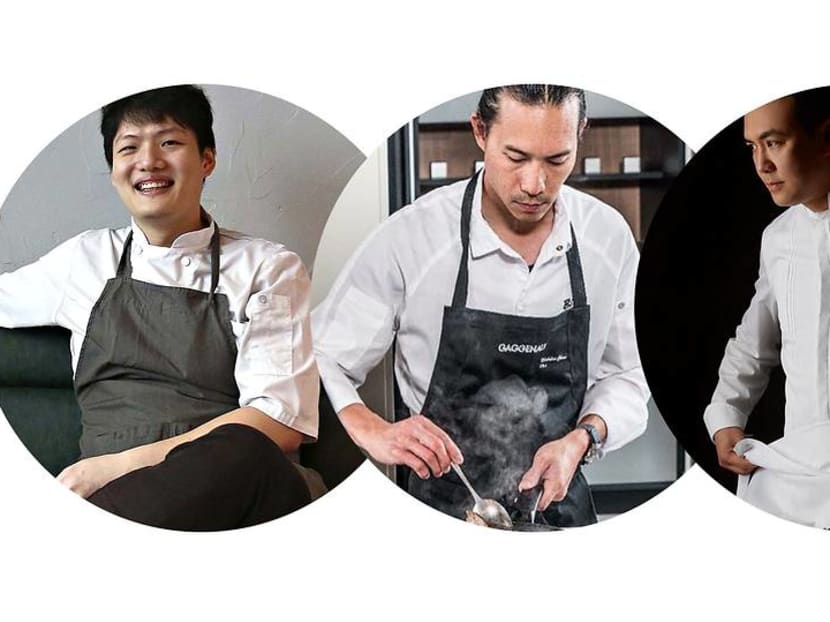
Barry Quek, Nicholas Chew and Edward Voon. (Photograph: Barry Quek, Nicholas Chew, Edward Voon)
06 December 2022 06:30AM (Updated: 04 Jul 2022 eleven:52PM)
Born and raised in the heartlands of Singapore'southward Pasir Ris, Barry Quek is known as one of the nearly talented yet modest chefs in Hong Kong'south culinary landscape. His first F&B office was a job at McDonald'due south at the historic period of 14. He admits today with a smiling that he weighed 100kg when he worked in that location, simply National Service saw him make it shape and cement his love for the industry.
"When I was in the army, I saw an commodity on a culinary schoolhouse, Sunrice. I spent xv months there, learning all the fundamentals, from knife skills through to front-of-house. Earlier I graduated, they asked me where I wanted to apprentice so I tried my luck and said Joel Robuchon in Sentosa. 2 weeks later they said in that location was a cook position."
Although the eating place might seem like a holy grail to a budding chef, Quek admits that the feel in the famed Michelin-starred spot was barbarous.
"It was so hardcore, worse than the Army! Regular army training got me through it. The staff always had to be quiet, everything was very precise, done the Robuchon fashion. I and then went to Les Amis in 2013, before moving to the Flemish office of Kingdom of belgium to work at In De Wulf for 4 months. I loved every single minute of it.
"It was the start time that I travelled overseas or foraged [for ingredients]. [I too learned about] fermentation [techniques], which was very different from classical French cooking. Then I heard nearly Attica in Melbourne and did a stage (internship) for three months under Ben Shewry, someone so humble and down-to-earth."
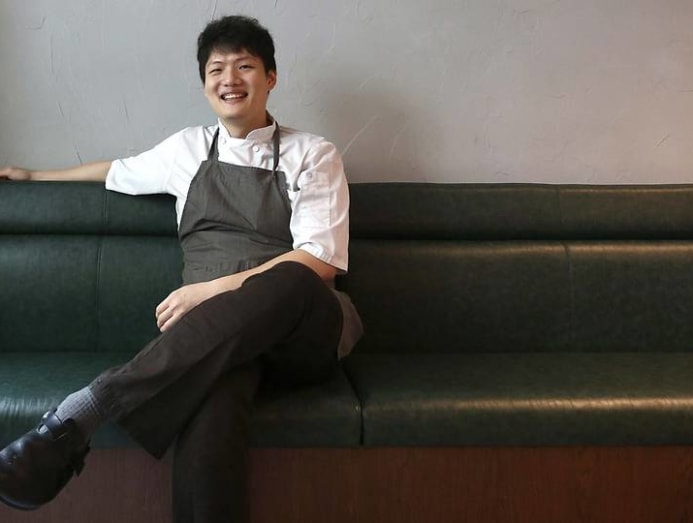
READ> How this Singaporean came to make pasta 'as expert as an Italian grandmother'
His global journey continued as he flew to work at Portland in London for 15 months, before joining Clipstone where he spent two-and-a-one-half-years. He also got to eat as much as possible beyond the British capital.
"Helene Darroze at The Connaught; St John; Motion-picture show; The Dairy – the range of cuisines was so much wider and there was phenomenal produce. I went downwardly to Cornwall and Devon and would speak straight to the farmers."
He then got a phone call from the owner of Beet in Hong Kong request if he was interested to work in Asia.
"I wanted to be somewhere closer to Singapore so Hong Kong came forth at the right fourth dimension and I moved there in September 2017. People don't cook at home much in Hong Kong; they eat out more. What people are willing to endeavor has a ameliorate chance than in Singapore, but having said that, in the last few years Singapore has as well really come forth."
To the huge thwarting of Hong Kong's gourmands, Beet shuttered this year, simply consultancies, including the blast hit Return of Lemak at the city's BaseHall food court, have kept Quek busy. He likewise has a number of exciting projects with the ZS Hospitality Grouping that are set up to open in the adjacent few months.
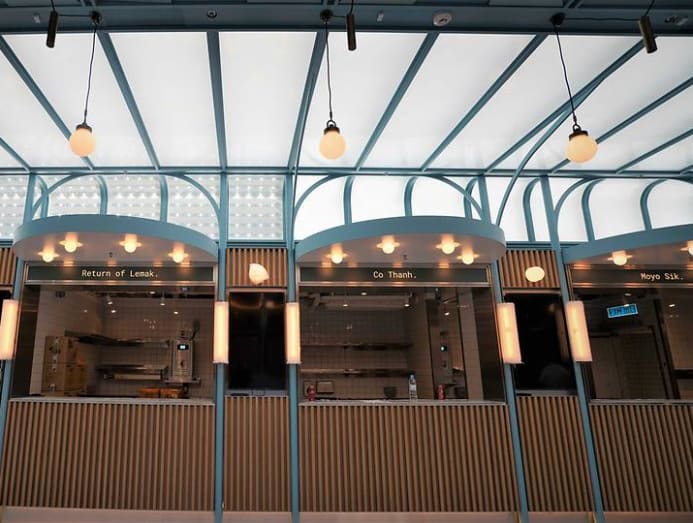
"Return of Lemak has been an amazing feel at BaseHall and made me realise how much I miss Singaporean and Malaysian food. I didn't capeesh it until I left, the noesis in terms of [how to cook] a uncomplicated curry or rendang, the art of cuisine. I take my lid off to hawkers in Singapore and everywhere. [At Return of Lemak] I made a hybrid of all the laksas I've tried, a Peranakan version with achar. We also serve Milo dinosaur, Cendol and even a Michael Jackson!"
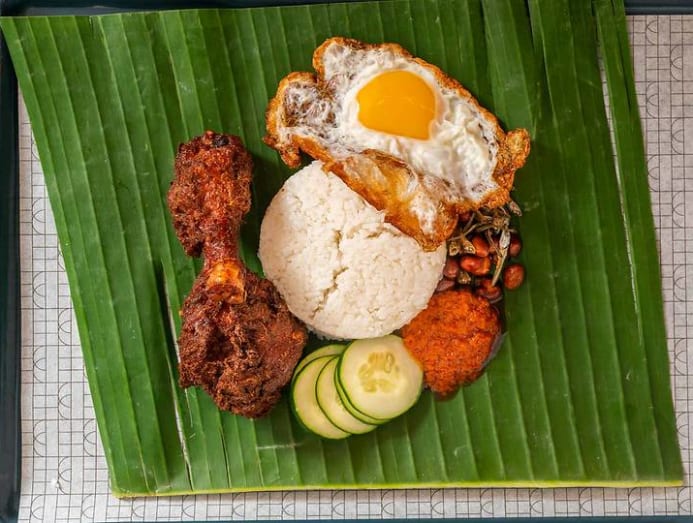
Every bit to a move dorsum abode, Quek said: "In the time to come I might motion back, only not within the next v years. For me to move dorsum it would be considering of family.
"I also want to cook something Singaporean and approachable, closer to my roots. I'm Hokkien so desire to practise something Hokkien and Singaporean, maybe [an equivalent of] Candlenut for Hokkien cuisine or a restaurant like (the hugely popular Thai restaurant in Hong Kong) Samsen – not strong, relaxed, like a neighbourhood hawker with aircon!"
"I take my hat off to hawkers in Singapore and everywhere." – Barry Quek
KATONG BOY MADE GOOD
Some other very well-respected name in Hong Kong's fine-dining scene is Nicholas Chew, who is of Peranakan descent.
"[When I was growing up], I lived in Katong. My dad is Singaporean but my mum is Malaysian, so I accept a lot of babyhood memories of Malaysia – specially Johor Bahru and Petaling Jaya – where I spent my school holidays.
"I'k from a Peranakan background. My immediate family is very close: We used to gather around our grandparents' homes on weekends and our multicultural mix meant we historic all the festivals with big feasts."
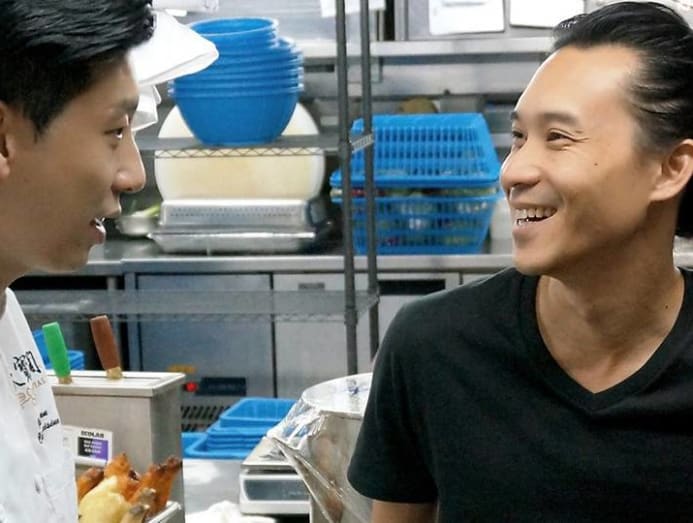
Chew explained that his father was an expressionist painter, so his childhood was surrounded by "a lot of fine art". He enrolled in art school, studying environmental pattern, interiors and architecture. One of his projects was a Japanese eating place.
"That was the first time I saw a Japanese chef, getting so hands-on with everything. It was my outset taste of seeing food as an art course – the civilization of tradition, from the start to the end, a chief in creation, this was another level of design. You stimulate emotions and the heed every bit an artist, simply equally an artist in food yous offset nourishing the body."
At 19 he finished national service and went to Japan for a few months to apprentice at restaurants. There, he started out washing dishes and met some less than warm Japanese chefs. "You are third or fourth class, washing rice every twenty-four hour period for two months. You starting time to larn perseverance!"
Later returning to Singapore, he worked in Japanese restaurants for seven years including at the now-defunct Eating house Kei at Robertson Quay and Nadaman at Shangri-La.
By then, Chew had met his time to come wife who was headhunted for a mail service in Hong Kong, and when he arrived in the +852 he got a telephone call he couldn't refuse.
"The eating place L'Atelier de Joel Robuchon chosen me. It was a very junior position with a very old-school French chef, my first take on how the French brigade system worked. We'd see Monsieur Robuchon coming in every iii months. Everything had to be tip-superlative and in the Atelier a lot of produce was Japanese, so I knew a lot of it already. It was an open kitchen with planchas (hotplates) which felt like a teppan, so I thrived in this mix of east-meets-west."
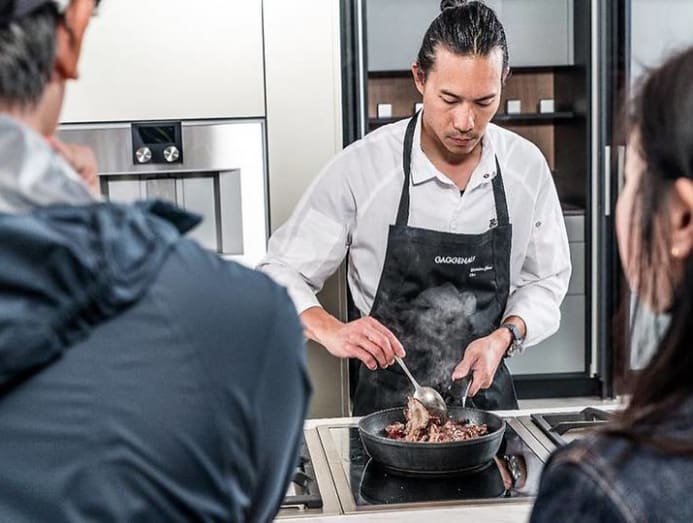
He spent simply under a year in what was so a two-Michelin-starred restaurant, then joined famed restaurateur Alan Yau's St Betty at the International Finance Centre.
It was run at the fourth dimension past the hugely-respected Australian chef Shane Osborn, who opened Chew'due south eyes to the reality of two-Michelin-starred levels in London, where Osborn had come from.
Thereafter he joined restaurateurs Charles Pelletier and Fred Peneau at a eating house called Serge et le Phoque, located in the center of Hong Kong's Wan Chai Market.
"We had to sponge as much information equally we could as fast as nosotros could. We'd work from 8am to 2am for the first few weeks and sleep on sofas in the restaurant every bit we were so exhausted. We were experimenting then much, removing layers of cuisine, learning how less is more. If y'all've got a good product to begin with, let it smooth. Nosotros were in awe learning this new concept of cuisine."
The restaurant was quickly awarded a Michelin star, but unfortunately airtight when Pelletier and Peneau relocated to London. Chew'south next move was to Bibo, an art-filled space on Hollywood Road where he was to make his own name and win a Michelin star.
"I had a blank canvas at Bibo, so nosotros did a 'Singaporean-meets-French' bill of fare – my roots mixing with what I learnt over the years.
"The Southeast Asian flavours were so intricate to combine, but eventually nosotros were confident and the outset dishes emerged. And then for example we cooked celeriac similar a risotto, sucking up the flavours like rice. We used the influence of laksa to make my signature dish, a laksa-based, non-starch risotto. We had variations on chicken rice likewise – over again, my heritage – interpreting the concept as something else."
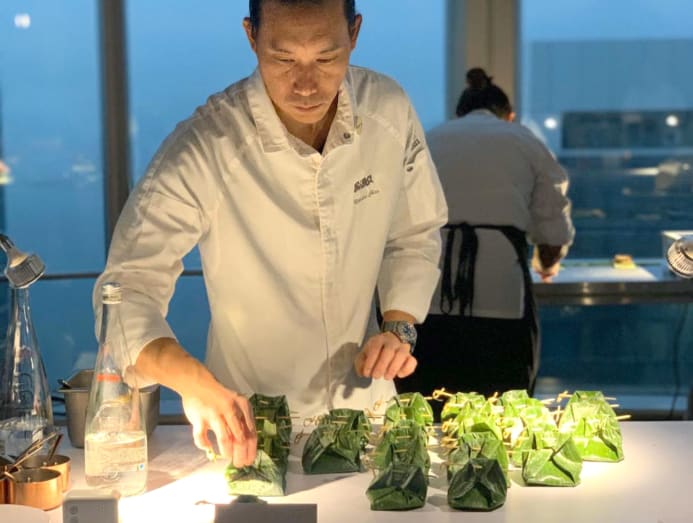
Since Bibo shuttered before this yr, Chew has been running Guerrilla Lab, taking on exciting projects with individual clients while cooking in beautiful, luxurious homes.
As to if or when he'll render to Singapore? "I'd never say no to future projects, in Singapore or anywhere. My wife is Singaporean, and then we consider Singapore home. I've been out of Singapore a skillful 15 years, a long time. Over the last five to 10 years, Singapore's restaurant mural has been growing fast, but the finesse in the Hong Kong market and dining scene is still a level upwards."
"You stimulate emotions and the mind as an artist, but as an creative person in food you showtime nourishing the body." – Nicholas Chew
NO MICHELIN STAR, NO WORRIES
For Edward Voon, who left his native Penang at historic period fifteen to pursue his culinary dream in Singapore, the Mandarin Oriental proved to be the starting point that gave him a platform to learn the craft, the produce, and the techniques.
He conspicuously made a positive impression equally, post-obit a stint where he adjacent worked at the Belfry Club as sous chef, the Mandarin Oriental invited him back again to open their poolside Italian favourite, Dolce Vita. Thereafter Voon opened the first molecular gastronomy dining destination in Singapore, Aurum.
"It gave me an opportunity to learn something out of the box and to be very creative in gustatory modality," he said. "We engaged a Spanish chef who was a disciple of Ferran Adria. Information technology was then rewarding learning a new culture, cuisine, fundamentals."
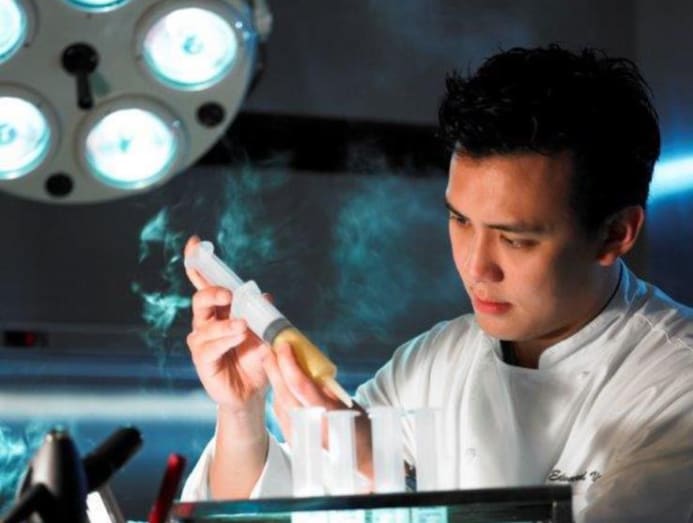
And then along came Hong Kong billionaire Pan Sutong. Voon had visited Hong Kong 14 years previously, invited past horologist Richard Mille to cook at an event. Sutong was one of the guests, had Voon'due south food and rang him upwardly, asking him to cook dinner.
"I was almost to open my own restaurant. I had money in the banking concern, information technology was ready to go, a mod Japanese concept. Mr Pan told me to postpone my plans as he said 'I'm going to open up the restaurant of your dreams'."
He hired Voon to work for him equally a individual chef and travelled the world, cooking for him in the Napa Valley, Bordeaux, London, and across China. Just after seven years, Voon felt that he had lost his border cooking in the same kitchen every day, then he began planning the opening of his current eatery, Le Pan.
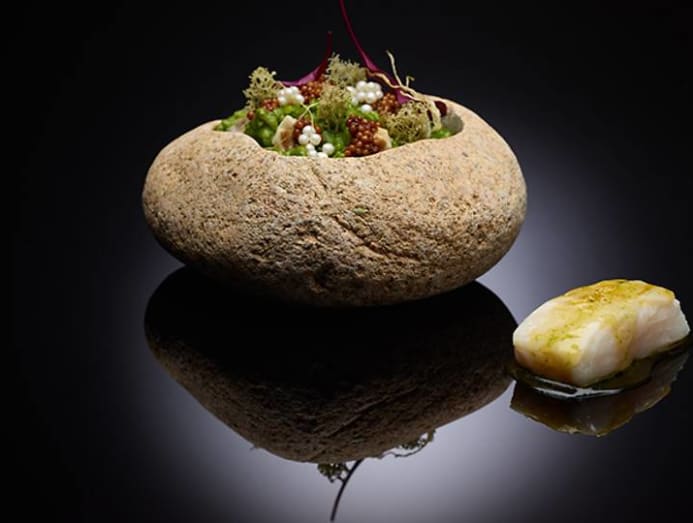
"Food has to be exciting and I want to present my roots and story. My mission is contemporary French… [just I also desire my guests] to taste something familiar. And then [for example] the sauce for my ravioli is beurre blanc, simply modified with black bean."
Despite his years of being away, the lure of Singapore remains strong, peculiarly its food.
"I love to eat everything, peculiarly in Singapore! The bak chor mee on Hill Street. They open up at 9am, but I'thousand there at vii.30am every bit the queue is so long! I eat 3 bowls. I actually just moved my family back to Singapore from Hong Kong as it was time to go back. Maybe I'll exist next. I love Hong Kong but my wife and children followed my dream in Hong Kong for xi years – I experience I demand to return these 11 years to them."
The divergence betwixt the two cities is clear, however.
"Singapore is a small island surrounded by great local food. Amid those looking for fine-dining, I believe Hong Kong has the edge. In Singapore everybody is waiting for someone else to pay the bill, in Hong Kong anybody is fighting to pay for information technology! People in Hong Kong are willing to take risks – they get out, they drink like crazy. It'due south a unlike culture and upbringing."
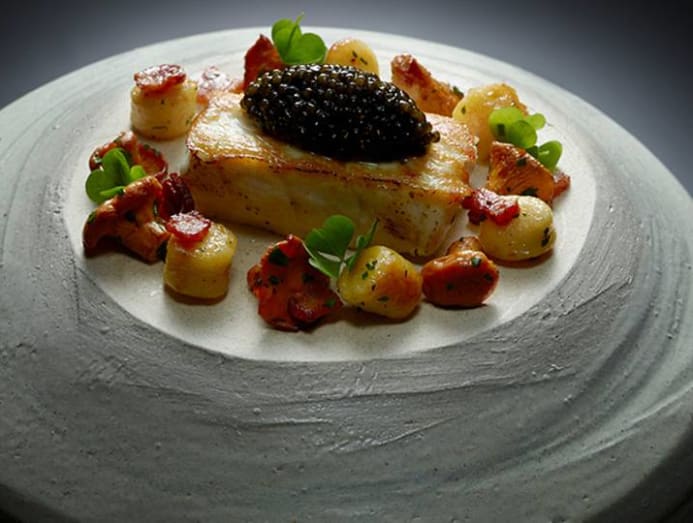
With 1 of Hong Kong's most elegant dining rooms, flawless service, a strong vino list and Voon's infrequent cooking, it's a great surprise that the Michelin Guide has not recognised Le Pan with a star.
But Voon is laid-back about it, focusing instead on his inventiveness. "[The Michelin Guide reviewers] are doing their thing, permit them be. My friends are artists, celebrities, business people, so I have exposure to unlike minds, tastes and reasons. If yous mature through chat, you mature through cooking."
When Voon eventually returns to Singapore, equally with Quek and Chew, the city's diners are going to be in for some serious culinary excitement.
"Food has to be exciting and I desire to present my roots and story." – Edward Voon
READ> Hong Kong's hottest new restaurants you've missed since lockdowns began

Recent Searches
Trending Topics
reynoldscounsomed.blogspot.com
Source: https://cnalifestyle.channelnewsasia.com/people/singapore-fine-dining-chefs-in-hong-kong-246926
0 Response to "Who are the Singapore fine-dining chefs flying the flag high in Hong Kong?"
Post a Comment