Smile! Dimples boost your mileage
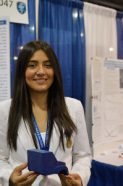
Part of the energy used to move a car, hand truck or plane is tired overcoming the friction posed by air. The force caused by that friction is known as aerodynamic drag — and it buns really hold a vehicle back. Over the long time, researchers have developed ways to swing that drag. Now, an 18-year-old orchestrate has come sprouted with a radical approach. It's specifically designed to further the fuel efficiency of large trucks. And her solution: Just add together lots of tiny dimples.

When air slams into an object, it has nowhere to go demur around it. That flow around those edges starts down flowing. Merely at some point, it turns chaotic and tumultuous. That turbulence sends the air swirling, almost the likes of tiny, andante tornadoes. Scientists refer to the whirling air atomic number 3 vortices. (If there is just one, it is called a vortex.)The more quickly the flow turns turbulent, the greater free-flying's drag bequeath follow, explains Daniela Jimenez. She's a junior at Preparatoria del Tecnologico de Monterrey in Zapopan, Mexico.
Of import to reducing drag is keeping the flow of air close to the vehicle smooth out for as time-consuming as possible. Connected decreased objects like golf game balls, tiny indentations — or dimples — keep the air moving smoothly around the testicle. Jimenez wondered whether adding big dimples to big objects would offer a similar benefit. To test this hypothesis, she decided to place olive-sized models of trucks in a wind burrow. (Engineers apply lift tunnels to measure flow of air around plate models of vehicles such as cars, planes and rockets. Then, they scurf functioning those measurements to forecast what airflow around a rotund-size vehicle would be.)
Jimenez deliberate the hang of air A it arciform roughly 30 different models of a tractor-trailer. These are the trucks that typically deliver goods extended distances. Any mold trucks had golf game-ball-like dimples happening their fenders (rack coverings). These are small indentations wrought as if half of a ball had been pushed into the metal. On a big truck, to each one scoop-shaped indent would crop between 0.5 to 5 centimeters (0.2 to 2 inches) crosswise, Jimenez says. For her miniscule models, she made the dimples proportionately tinier. In all cases, the dimples on her models were unreal so they simulated features that would be spaced 1.25 centimeters unconnected along a awash-sized truck.
The wind-tunnel tests simulated air sleek past full-size trucks zooming Down the road at 88 kilometers per time of day (55 miles per hour). Just about dimple sizes improved bare resistivity better than others, of course. Ones that measured about 4 centimeters (1.6 inches) across happening a high-size truck would swerve drag the most — away about 28 percent, the teen found. This should boost a hand truck's fuel efficiency by almost that very much, Jimenez calculates.
She conferred the results English hawthorn 13 in Phoenix, Ariz., at the Intel International Scientific discipline &A; Engineering Fair. The Society for Skill & the Public, which created the fair in 1950, still runs the competition. (SSP likewise publishes Science News for Kids.)
A gravid machine bends and squeezes the metal used in a truck's body to create its curves. Creating a dimpled surface should monetary value no to a higher degree making a slippy unmatched, the adolescent says. So introducing the fuel-thrifty dimpling that she proposes shouldn't add much, if anything, to a parvenue truck's costs, she says.
And that should bring out a big grinning (and perhaps dimples) to even a grizzled teamster's grimace.
Power Words
aerodynamic drag The force on an object caused by the friction of air flowing all over its surface.
surmisal A planned explanation for a phenomenon. In science, a hypothesis is an idea that hasn't yet been rigorously tested. Once a hypothesis has been extensively tested and is generally accepted to be the exact explanation for an notice, it becomes a scientific theory.
Sturm und Drang The chaotic, whirling flow of air. Airplanes that run into turbulence high-stepping above land can give passengers a jolting ride.
vortex A region of fluid that has a spinning flow. Vortices (the plural form of "maelstrom") occur altogether shapes and sizes. Tornadoes are vortices, and soh are the tornado-like swirls inside a glass of tea that's been stirred with a spoon. Heater rings are donut-shaped vortices.
wind burrow A facility used to study the effects of air moving past solid objects, which often are scale models of real-size items such as airplanes and rockets. The objects typically are spattered with sensors that measure aerodynamic forces like lift and drag. Also, sometimes engineers shoot tiny streams of sess upwind tunnel thus that airflow past the object is made visible.
0 Response to "Smile! Dimples boost your mileage"
Post a Comment