What Aspects of Romanticism and Realism Is Evident in Todays Media and Art?
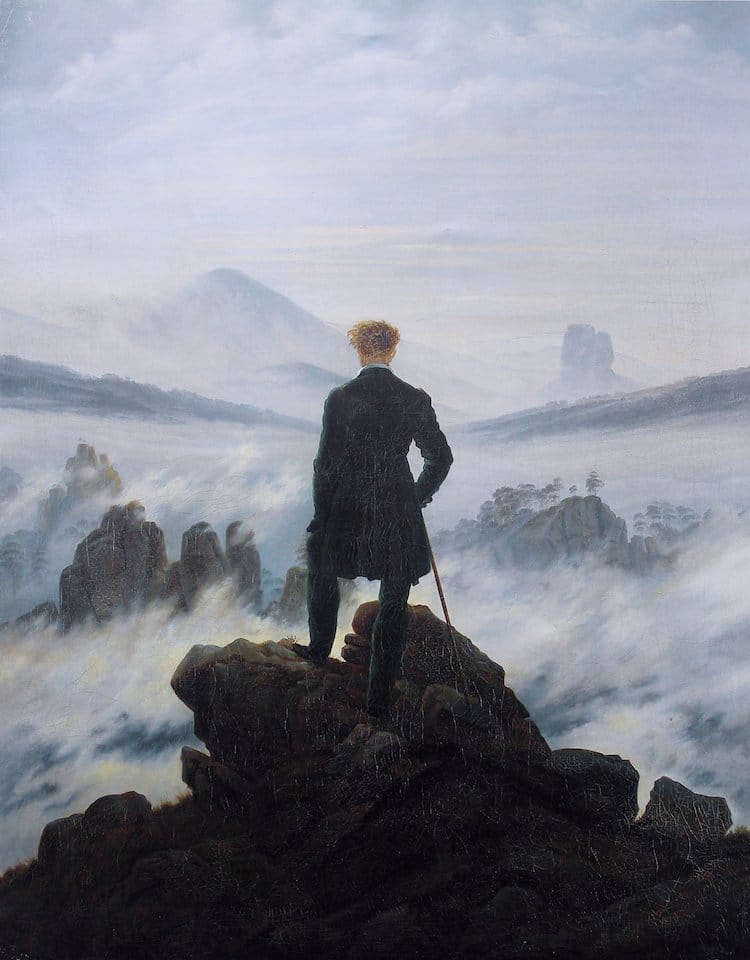
Caspar David Friedrich, 'Wanderer Above the Sea of Fog,' ca. 1818 (Photograph: Wikimedia Commons Public Domain)
Throughout art history, many major art movements emerged in response to existing artistic approaches. Pre-Raphaelite painting, for instance, was built-in out of a dislike of the Renaissance, while Rococo artists built upon the opulence of Baroque art. Though this phenomenon has manifested time and time again, it reached a height with the onset of Romanticism, a move that rejected the formality of Neoclassicism and, instead, embraced emotion.
Today, the Romantic genre is mostly associated with large-calibration paintings. However, the movement influenced several disciplines and branches of study, culminating in a legacy axiomatic in the visual arts and beyond.
What was the Romantic Period?
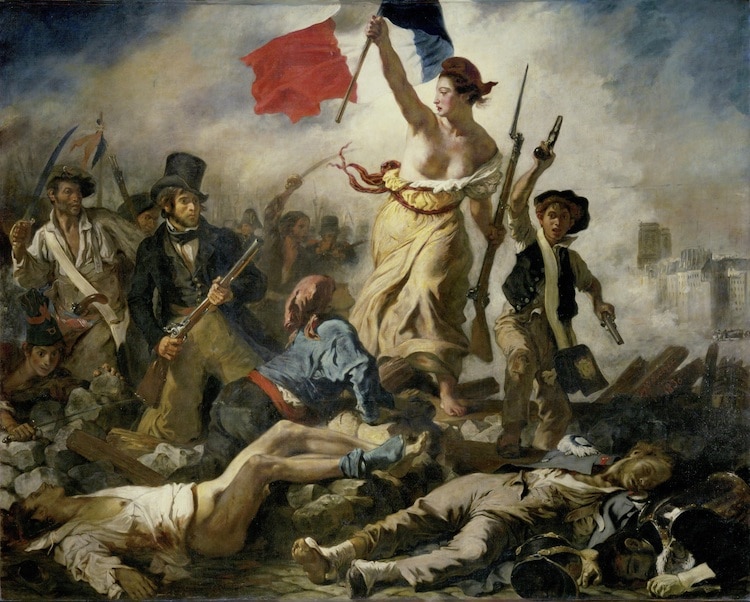
Eugène Delacroix, "Freedom Leading the People," 1830 (Photo: Wikimedia Commons Public Domain)
Romanticism was a cultural movement that emerged effectually 1780. Until its onset, Neoclassicism dominated 18th-century European art, typified past a focus on classical subject field matter, an interest in aesthetic thrift, and ideas in line with theEnlightenment, an intellectual, philosophical, and literary movement that placed accent on the individual.
While Romantic figures agreed with the Enlightenment'southward involvement in individualism, their arroyo diverged from the Neoclassicists. Instead of looking back to classical models, artists likeJoseph Mallord William Turner, Eugène Delacroix, Theodore Gericault, Francisco Goya, and Caspar David Friedrichplant inspiration in their own imaginations. This introspective approach lent itself to an art form that predominantly explored the spiritual side of humanity, the sublimity of nature, and, above all else, the fruits of personal freedom.
"If by 'romanticism' one means the free manifestation of my personal impulses, distancing myself from the rules fix in schools, and my distaste for the recipes of the academy," Delacroix famously remarked, "I must confess that non only am I a romantic, I was from the historic period of 15."
Romantic Paintings
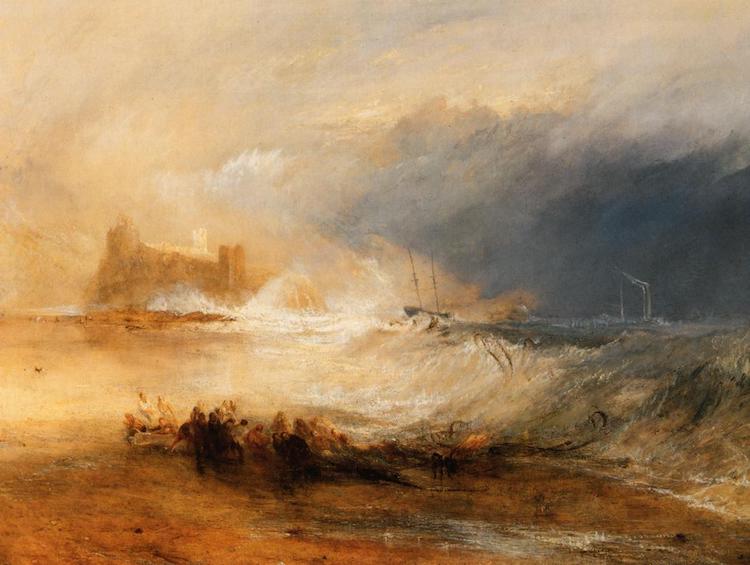
"Wreckers, Coast of Northumberland," c. 1834 (Photograph: Wikimedia Eatables Public Domain)
In general, Romantic artists worked in ane medium: paint. Specifically, in the movement'due south early years, these figures predominantly focused on landscape painting. The Romantic landscape genre was primarily pioneered by JMW Turner, a British oil painter, watercolorist, and printmaker. Early in his career, Turner was associated with the Neoclassical movement, simply a trip to the Swiss countryside sparked an artistic interest in nature, which materialized as an imaginative and untraditional approach to painting.
"A master of history, landscape and marine painting, he challenged the style of the old masters, trailblazing in technique and subject thing," the Tate Britain explains. "Turner often shocked his contemporaries with his loose brushwork and vibrant color palette while portraying the development of the modern world unlike whatever other creative person at the time."
Turner'south emotion-driven style paved the style for other artists, including Caspar David Friedrich, whose powerful paintings explore the relationship betwixt human being beings and their sublime surroundings. However, Turner'south piece of work also inspired Romantics who didn't specialize in landscapes, like French artists Eugène Delacroix and Theodore Gericault. Like Turner, these figures employed expressive brushwork to heighten the drama of their action-packed paintings, including Freedom Leading the People and The Raft of the Medusa, respectively.
Other Disciplines
While well-nigh Romantics stuck to painting, some dabbled in sculpture. Amidst the most well-known of these artists isFrançois Rude, a French sculptor who crafted Le Marseillaise, a grouping of reliefs on Paris' Arc de Triomphe. However, aside from painting, Romanticism plant almost of its success across the visual arts.
Some of the 18th and 19th century'due south most well-known composers worked in the Romantic style. These include Ludwig van Beethoven, who also worked in the preceding Classical period, besides equally Pyotr Ilyich Tchaikovsky,Franz Liszt, andRichard Wagner. Similarly, Romantic interests flourished in the field of literature, with English poets likeWilliam Blake, William Wordsworth, and Samuel Taylor Coleridgeleading the way with their sensitive written works.
Romanticism likewise touched more academic disciplines, including education and both the social and natural sciences. In any instance, Romanticism challenged leading intellectual ideas of the time, culminating in a flow unlike any other. "There was something pioneering—most revolutionary— nearly Romanticism," the National Trust says. "Information technology involved breaking with the past, and consciously moving away from the ideas and traditions of the Enlightenment. In so doing, Romanticism fundamentally changed the prevailing attitudes toward nature, emotion, reason and fifty-fifty the individual."
The Legacy of Romanticism

In the middle of the 19th century, the cycle of fine art history continued, and artists began reacting against the ideas associated with Romanticism. This shift in interests culminated in the emergence of Realism, a French movement that introduced the thought of boilerplate, working class people, contemporary settings, and solar day-to-24-hour interval scenes as worthy artistic subjects.
Though, at its pinnacle, the Romantic period lasted no more 50 years, the move remains a prominent piece of art history. Today, Romantic paintings past Delacroix and Gericault are amid the Louvre's most treasured masterpieces; Goya is widely considered to be the concluding Old Master and the get-go of the moderns, making him one of Kingdom of spain's almost important artists; and, perhaps well-nigh chiefly, the Romantics' honey of nature helped inspire contemporary environmentalism. Subsequently all, as Friedrich wrote in 1803, "The whole of nature breathes, peace, joy, innocence and life."
Related Articles:
25 Fine art History Terms to Aid You Skillfully Describe a Work of Art
Here'south Where 15+ of Fine art History'south About Famous Masterpieces Are Located Right Now
seven of Art History's Most Horrifying Masterpieces
reynoldscounsomed.blogspot.com
Source: https://mymodernmet.com/what-is-romanticism/
0 Response to "What Aspects of Romanticism and Realism Is Evident in Todays Media and Art?"
Post a Comment